
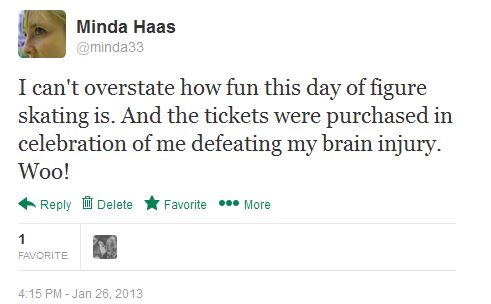
Sometimes on Twitter I make reference to my brain injury, but it occurs to me that I’ve never told the whole story. And until everyone – EVERYONE – takes concussions more seriously, people like me need to be more vocal. So here’s the story of how concussions broke me, but also how I got to the point where I could triumphantly tweet this:
Part I: “What the hell is happening to me?
The start of the whole mess didn’t feel like the start of anything of any significance. Before a family dinner at my brother’s house, I felt kind of woozy and went to the guest room to lie down for a bit. It didn’t help, and in fact that woozy feeling stayed with me for well over a year. If you’ve ever fainted before, you might know that twilighty feeling, where you’re aware that you’re about to black out, but you’re somehow too detached from consciousness to do anything about it. Starting that day in February 2011, I felt like that all the time.
That night my dad took me to an urgent care clinic. I did a bunch of balance tests and was somewhat reassured by the doctor’s pronouncement that I had not suffered a stroke. I repeated those balance tests obsessively at home, standing on one foot on a pillow for as long as I could to make sure I could still do it.
The woozy feeling was worse when I moved too suddenly, or sang too much, or walked too fast. Much worse, though, was the fact that my memory started getting slippery. If I tried to read a textbook or a blog post or the minutes from a meeting, I could recognize the individual words but failed to retain any meaning or message from them. The names of people I knew and saw every day were suddenly a mystery to me. I found myself doing that really sad “Hey….you! What’s up….pal?” thing that I imagine people in the early stages of Alzheimer’s do. Except, this was happening to me at age 22, not 82, and I had no idea why.
And then there were the migraines. I had about three of them per week, plus a constant dull ache in the back of my head. Looking back later, I realized that headache, and the increased migraines, plus a constant ringing in my ears, had actually started earlier. But I’m getting ahead of myself.
Other things that happened included numbness in my hands and feet, which got pretty severe. It felt like my body forgot that it had feet underneath it, so when I walked I would be surprised every time my forward progress was halted by these shoe-wearing things that kept landing on the pavement underneath my ankles. And all the time, I was just…so….tired.
Part II: 14 Hours of Sleep Per Day
It’s hard to be a college senior with classes, a job, a blog, and friends when your body thinks it needs 14 hours of sleep every day. I would get up and go to classes, if only to attain attendance points. I couldn’t remember anything from the lectures and I didn’t have the energy to keep up with taking notes. Recording lectures was a nice idea, but when would I listen to them again? I was sleeping all the time when I wasn’t physically in a classroom.
I was a pretty terrible friend in those days. I still hadn’t quite figured out what was wrong with me, which made it ever harder to explain why I couldn’t hang out, or go to this concert or that ballgame or whatever. And my friends were not the only people with whom I struggled to communicate…
Part III: Explaining Without the Right Words
Before I put together what was happening to me, I had to figure out how much to say to which people about my situation. I made the decision early on that I wouldn’t bother trying to explain my situation to “single-serving friends” and passing acquaintances. With them, I would just try to pass as a normal person, even though I was far from being the actual Minda.
Teachers were another matter. They needed to know something about why I looked half-asleep during classes, why my responses to class readings sucked, what I wanted them to do in the event that I passed out during class (call an ambulance, and my insurance card is in the front pocket of my backpack). “Some thing is wrong with me, but I don’t know what, but I need you to adjust everything for me” is what I felt like I was asking.
I wanted to let my friends and coworkers in on what was going on, but since I lacked the language to explain my constant fog and my sudden memory loss and my ridiculous sleep schedule, I mostly kept quiet. I understand why they couldn’t (and still can’t) get it: How could they imagine a brain that doesn’t work, when theirs are just fine? It was pretty lonely.
Part IV: Doctors not named Gregory House
I started going to doctors, because all I knew at this point was what the doctor at urgent care had told me: I did not suffer a stroke. After lots of visits to all manner of doctors, that was still all I knew. Everyone kept telling me I needed to see a neurologist, but I already had, and he was the most useless of the whole lot.
Lots of well-meaning people started weighing in with ideas that started to sound like the first half of any given episode of House, M.D. Suggestions from various places included mercury poisoning, a migraine disorder, pregnancy, protein deficiency, dehydration, low blood sugar, high blood sugar, low blood pressure, high blood pressure, thyroid problems, heart defects. The most maddening of these was “well, you’re just stressed.” No, I wasn’t, until my brain started (figuratively) leaking out of my ears for no reason, but thanks for being so condescending in my time of peril, people! Augh.
Part V: A-Ha! (not the band)
My mom did a lot of Googling for me when I was too sick to figure this stuff out on my own. She and I had curated a list of my symptoms and it was probably pretty ingrained in her mind as she shuffled through countless message boards and articles searching for some clue as to what the hell was wrong with her daughter. Young people don’t just lose their brain function for no reason, do they?
After a while, it clicked. Post-concussion. Sure enough, I’ve had concussions. How many of them? I don’t know. It really doesn’t matter. There’s not a magical number of concussions that a person can have before they’re affected. The number is “one too many.” But I had had a pretty bad one in a car accident, just a little while before the worst of my symptoms started. I was examined by an ambulance crew at the scene. They chalked my haziness up to shock and let me go. I went to the ER a bit later, and was dismissed right away. The staff there sure didn’t think anything would come of it, and didn’t prescribe any follow-up care.
I didn’t make the connection at first because the fog and the memory stuff came a few months after the concussion. But when I looked back, I realized that the headache in the back of my head, the one that was always there? It started long before the fog did — right after the accident. So did the more-frequent-than-usual migraines. I just noticed those more after I started tracking my other symptoms every day.
I took a list Mom had compiled of commonly reported post-concussion symptoms. I started highlighting the ones I had suffered, and almost all of the 20+ things on the list were highlighted. I saved that list into my phone, and started taking it with me to all my newest new doctors.
Part VI: More Doctors (and their bills)
The clueless shrugs that I had received from most doctors turned into worse experiences in Round Two of my quest to fix my brain before I gave in and blew it to bits with a gun.* I had to beg and plead to get any kind of relevant testing done. To my surprise and dismay, doctors didn’t want to do brain imaging even though my brain was pretty faulty and probably merited a look-see. One very rude staff compromised by doing an EKG for some reason, so at least I knew that my heart was in good working order.
*I don’t make that comment lightly. At a certain point, when your brain doesn’t work, you start to really question what the point of staying alive is. When people like Dave Duerson and Junior Seau died the way they did…I understood. It’s a marvel to me now that I didn’t meet the same end.
After that, I started getting rejected before I even made it into the door. More than once, I heard “I’m sorry, that sounds like it’s a little bit outside of this office’s specialty.” They didn’t sound too sorry, and I thought I would never find a doctor whose specialty was “brains that go haywire a little while after a concussion.”
I thought I found one, once. She was my last hope, as far as I was concerned. The guy who recommended her said she’d really listen, and get creative in trying to find me some help. Instead, she sent me to an ENT, who sent me to a hearing lab to get my hearing tested. (It’s excellent, but I already knew that.)
There were, of course, bills for all of these visits.
Part VII: “Good enough?” Giving Up.
Since my “last hope” doctor didn’t provide me any help, I was ready to give up my search and move away from Omaha, back to my parents’ house. If my health didn’t improve, there was no way I could function enough to live independently, and I couldn’t live with my brother forever.
I could only work a few hours per day at my job that was supposed to be full-time, and every day when I had to go home early, I felt like a huge failure. But I was exhausted, all the time. I started my workday exhausted because it took all my energy just to navigate the roads to my office. My brain was no longer equipped to keep track of 4 lanes of traffic or watch my own speed or remember which lane to get into for which exit. The daily commute for most people is pretty much muscle memory. For me, since I had no memory, I had to consciously make every single decision in my car, and remind my hands to keep a grip on the steering wheel. If I didn’t do that, they’d slip down into my lap and I would have no recollection of how they got there.
[Note: Writing this has been exhausting and painfully sad. I sometimes forget how bad things really got, and revisiting the worst of it has left me in tears. If you’ve read this far, thank you for sticking with me.]
I still had to sleep all the time and my friends still never saw me. And when I did go out, it was only ever for a few minutes and then I’d have to go back home and sleep some more. This was all very depressing.
Part IX: Washington, Washing-ton. Or not!
A year ago last week, my parents happened to find a left-behind copy of some magazine in an empty pew at church. For some reason, they decided to actually read it rather than just leaving it back in the pew. And somehow, my mom saw an article about a woman in the DC area whose daughter’s life was ruined just like mine. But then she got it back.
The treatment was called LENS, and it helped give life back to the daughter of this lady, Patty. My mom emailed Patty that night wondering if the treatment that helped her daughter could help me. Patty said yes, she thought it might, and we could stay at her house for free for as long as we needed while I was undergoing treatment. Because that’s what total strangers do all the time, right? Apparently Patty was so grateful for her daughter’s treatment that she would do whatever it took to help other families concussions were trying to ruin.
Just like that – after I had given up all hope that I would ever be ME again – we had an appointment and the beginnings of a treatment plan. I made arrangements to work remotely and tearfully told my coworkers how much I’d miss them. I was going to have to miss most of the Storm Chasers season, which was really a pity since I had a press pass and all, but it was a trade-in I was ready to make. Plus I’d get to go to Nationals games between treatments! Having some measure of hope was exciting, yet terrifying. Hope is actually one of the scariest things when you’re in a murky medical situation.
The night before I was to buy plane tickets for my mom and I to head to DC, the doctor in DC called my parents with some startling news: She heard there was a doctor much closer to me who was doing a very similar type of treatment. How much closer? Two and a half miles from my house.
As crazy as it sounds, I didn’t want to try the Omaha doctor, because I had so attached myself to the idea (and the published research and the accolades from everywhere) of this DC-area one. But Mom and I struck a deal: If I agreed to at least try the one close to home, she’d use the money we were saving to take me to the U.S. Figure Skating Championships in Omaha.
So I went. And the treatment worked! In short, LENS treatment manipulates the electrical currents in the parts of my brain that were malfunctioning, so the currents were more even throughout the brain. Without these electrical “dead spots,” my memory started coming back to me and I finally had enough energy to just be a person in her 20s instead of a sack of dirt that could never drag itself out of bed.
Part X: Better for now..but then what?
I’m enjoying being better, and giving the finger to the broken brain that is now in the past. I can read books again, and do math problems in my head, and think critically, and go out with my friends, and drive my car, and walk around knowing that there are feet attached to the rest of me. I can like myself and see purpose in my life again. And yes, Mom and I went to figure skating, and dammit, it was amazing.
But there’s still a little cloud following me around: What if it comes back? When I struggled to think of an actor’s name the other day, was it just a brain fart or am I on my way to being broken again? What happens when life gives me another concussion?
I know that “what if” thinking isn’t terribly productive but after everything I’ve been though, I am watching like a hawk for any sign that the nightmare is returning to me. I think that little cloud’s going to stick with me a while, but I’m alive – no: Alive, with a capital A – and that’s more than I thought was going to be possible back when I was in the fog.
Epilogue
One last thing, because this is a sports blog: Sometimes I hear people talk about how they don’t get what all the fuss is with athletes and concussions. They’re tired of all the news stories, and can’t be bothered with talk of CTE. Or they’ll call Justin Morneau a pussy (their word, not mine) for missing so many games after “all he had was a concussion.” If there is one thing that anyone can take away from this post, let it be this: Don’t you dare EVER use the phrase “just a concussion” when describing an athlete’s injury. Hearing that is a dagger to my heart. Take it from me: there’s no such thing as “just” a concussion.
__________________________________________________________________________________
Please consider supporting my writing and photography by doing your Amazon shopping through my affiliate link. (Explanation here.)
Related posts:
72 comments
5 pings
Skip to comment form ↓
Michelle
March 21, 2013 at 12:47 am (UTC 0) Link to this comment
I’m so sorry you had to go through this but so glad there is treatment now, I had no idea! Thanks for sharing!
caryn
March 21, 2013 at 3:07 am (UTC 0) Link to this comment
Thanks for sharing this, for the next mom up late trying to figure out what’s wrong with HER kid. And I’m glad you’re feeling better.
Minda Haas
March 26, 2013 at 1:55 am (UTC 0) Link to this comment
Thanks Caryn. That’s what I’m hoping will happen, especially for young sufferers.
chris carroll
May 15, 2014 at 6:49 am (UTC 0) Link to this comment
Minda I hope you are still getting these posts because I just had the same experience almost TO THE LETTER last friday!!! I am a 42 year-old husband and father of two. I was also a Biologist for fifteen years so I have a pretty well-rounded background on the brain. HUH, not even close. I was on an eight-foot step ladder trying to patch some siding on my wall. I have never had a fear of ladders and have done some crazy stuff in those hundreds of experiences. I wasn’t concerned even though the ladder wasn’t very sturdy and it slipped out from under me. At the time I had no clue that I had even hit my head. I landed on the stump of an old bush and was cut up and thought I broke my knee. My knee swelled so much that I went to the emergency room feeling positive that I would need a cast. In the middle of the night I was still awake (couldn’t sleep) when out of nowhere a feeling of (sorry the only way I can explain it) that was soooooo “dark”. That seemed to be the only word I could use. In actuality I thought I had burst a blood vessel or something and that I was simply living out my last couple of minutes on earth. THAT DARK and this is coming from an atheist. It subsided the next day but hit me ten times worse at night AGAIN. My wife took me to the hospital. I will tell you that I am a recovering alchoholic and “psycho-pills like xanax” addict sober a bit over a year.. Of course my wifes first thought was that I had had a relapse and that I taken too much of something. In the last ten years I did go up there once or twice for extreme depression but never od’d on anything.. Sorry to ramble on but I have to get this out. The orderly put me on a gurney in the hall and then everyone forgot about me. My wifw went home to be with the kids and I just sat in the hall watching the orderly’s and nurses take “selfies” with each other. I watched black apparitions fly around on the wall (again, non-believer of anything) and riled back and forth and back and forth. I probably looked like the exorcist. Long story short, everyone just sat around for two hours waiting for me, still being convinced that I had just ingested something. I couldn’t form a sentence let alone pee in a jar. The orderly go downright angry with me at one point and just left. I BEGGED and pleaded tfor them to just cathedorize me so I could get some medicine. I had to endure this for six hours before I got some relief. As you can probably see by my language and spelling I am still not 100 percent. One odd byproduct happened to me today… I can’t ever remember ever having such crystal clear thoughts, incredible insight, and problem solving skills that were exponentially higher than anything I’ve ever experienced in my life. This was such an indescribably profound experience that I am afraid I’m scarred for life. I certainly would welcome the intelligence byproduct for the rest of my life but the incredible horror that I felt those two nights would not come close to a trade-off. I would never, ever, ever consider something like suicide with my wife and kids on this earth but like you stated above I could have probably lasted another day like that and then it would have been over. I cant see a neurologist for another week but I want to know why all of the people around me were having such a laugh while I was sure I was dying. I have had many blackouts, hangovers, and hallucinations but this experience made dropping LSD look like eating a breath mint. It has been very therapeutic just writing this. Thanks a bunch.
chris carroll
May 15, 2014 at 4:00 pm (UTC 0) Link to this comment
Just read my post from last night. I have to apologize because since my concussion my thoughts have been very disjointed. Thanks again for your story it was like finding the elusive “silver lining.”
Kenn MacAdam
March 21, 2013 at 3:25 am (UTC 0) Link to this comment
Wow, amazingly revelatory. Congratulations to you and your mom for your perseverance. Really looking forward to reading your posts about the Storm Chasers and the Royals this year. Praying your medical comeback is permanent.
Troy Lewis
March 21, 2013 at 12:51 pm (UTC 0) Link to this comment
i am going to give this to a young man(16) who is suffering post concussive symptoms. im elated you offer a possible solution! As of now< he and his father arent dealing with "no more football" well. i am 43, and a presumptive sufferer of CTE.
i,too, want to have a stern chat with people who dismiss severity of concussions. especially someone close who knows better. thank you for your eloquence and passion. it will help someone someday. hopefully a young man who will read your words today! i struggle with my ability to communicate daily< but i find it imperative to thank and encourage people such as yourself to keep on keepin' on. I get emotional here, but its with gratitude and pride for a person who is spreading the word and potentially saving lives and the quality of many more lives. thank you!
Minda Haas
March 26, 2013 at 1:59 am (UTC 0) Link to this comment
Troy,
Thank you for sharing with me, too. Have you shared this with that young man yet? What did he say? I understand that it’s hard for a teenager (or even someone in their 20s and 30s trying to get/keep a career going) to really understand the risks of not taking concussions seriously. You don’t know what can really happen to your brain until it’s too late and it’s already happening.
What is it like to face the likelihood of having CTE?
chris carroll
May 15, 2014 at 7:10 am (UTC 0) Link to this comment
I have to apologize for butting in. I documented my experience above and feel like I have hit the lottery finding people with the exact same experiences with concussion. As I said above…thankfully I am not only a scientist but a year-sober recovering alchoholic and “psycho-med” addict. This at least gave me a heads-up because I have experienced many blackouts, hangovers, and bad “trips” and my concussion made those look like a day at the beach. I am a happy and healthy man and I was CLINCHED onto my wife in bed like an infant. Screaming in pain and talking to black apparitions. Since I am in recovery and I had absolutely no bump or bruise to show where I hit my head the hospital staff took their sweet time thinking I was just on too many drugs (year sober). I need some therapy…this has affected me more than the birth of my children (other end of the spectrum of course) and while I am feeling much better than average I am scared to death. I am sitting here crying and about ready to vomit. I’ll be fine. Any tips for immediate post-concussive health would be welcomed Thanks
Shanna
March 21, 2013 at 1:47 pm (UTC 0) Link to this comment
This is amazing. Yesterday marked the one year anniversary of me getting a major concussion while snowboarding. Straight into a tree & a broken helmet. The recovery was fraught with vertigo, lethargy, anxiety and the fear that I would never be “me” again. Thankfully I found a great neurologist who was able to help me greatly. Now, as I train for my half-marathon (I had to walk it with my mother at my side last year) I talk a lot more about concussions. When people can put a face to this health issue, it goes a long way.
Continued luck on your journey.
Minda Haas
March 26, 2013 at 2:00 am (UTC 0) Link to this comment
Shanna, your recovery story is amazing! Would you mind describing what kind of treatment worked for you? Obviously you and I had different paths to recovery with different types of doctors. I’d love to hear more about different successes!
Best of luck with your half-marathon!
Shanna
March 26, 2013 at 7:33 pm (UTC 0) Link to this comment
Minda,
The first few weeks, I was on a steady course of Mac & Cheese and Phish Food ice cream therapy. This of course was unconventional, but one of the few things that made me feel somewhat better. ;-) I didn’t really undergo many treatments as you did, but did work through the anxiety that developed (never had any issues before). I would recommend the Anxiety and Phobias Workbook as a great resource. Otherwise, my neurologist helped with a course of medications that have kept my anxiety at bay. Now that I am feeling more back to 100%, I will try going off the meds to see if I can go back to my pre-injury state. A lucky break for me was that my neurologist was a friend of the family and had a good frame of reference as to what my personality was like before.
I still have problems sitting down and focusing, especially to read a book. This would be something that I hope to regain soon as I miss reading. Feel free to email me and I can get into more specifics if you like.
Wanda
March 21, 2013 at 7:51 pm (UTC 0) Link to this comment
Thank you for sharing, Minda.
Section 36
March 21, 2013 at 11:20 pm (UTC 0) Link to this comment
All I can say is, “Wow. So powerful. So glad you’re back.”
Thank you so much for sharing.
Kathleen
March 22, 2013 at 4:25 am (UTC 0) Link to this comment
Minda – awesome article. Thanks for sharing. I remember you alluding to some of things you mention here on royalsreview but I had no idea the degree to which those symptoms were bothering you.
And regarding your “Epilogue” it makes me think of a recent trip I took to DC and happened to go to a medical museum affiliated with the Department of Defense. As you can imagine, they had a pretty extensive exhibit talking about the effects of trauma on the brain, and therefore the lives, of our military personnel. Especially about how the redesign of the helmet introduced in the 1990s combined with better trauma response medical treatment has led to a whole generation of veterans dealing with living with concussions. I’m sure it’s no mere coincidence that suicide rates among this generation are so high, nor that their treatment has been so ineffectual if what you experienced seeking help is anything to go by.
This is definitely not something that only affects NFL players, and it’s so ridiculous when people dismiss the study of the brain as this. If anything, I feel like every week we are learning how much the entire body (and soul) are affected by the health of our brain, and yet it is probably the part of our body that we least understand.
Minda Haas
March 26, 2013 at 2:04 am (UTC 0) Link to this comment
Thanks, K.
The heartache of PTSD is something I think about a lot these days. It is a shame that so many men and women are affected by it, but it’s encouraging to see the work that is being done to diagnose and treat it, as the INJURY that it is. The doctor I originally planned to see in DC works closely with returning veterans at Walter Reed.
Yeah, definitely not just football. Literally anyone can get a concussion, which means literally anyone can be at risk for the symptoms I went through.
Jesse
March 24, 2013 at 4:25 am (UTC 0) Link to this comment
Thanks for sharing! What is the name of your Doctor – and does s/he have an online presence?
Minda Haas
March 26, 2013 at 2:06 am (UTC 0) Link to this comment
Jesse,
Her name is Dr. Mary Lee Esty. She is well-published in topics like PTSD, and there’s a lot that comes up when you Google her. Her staff is very responsive and helpful. Even though I did not end up being a patient of Dr. Esty, she was still instrumental in my recovery.
Fake Ned
March 25, 2013 at 6:01 pm (UTC 0) Link to this comment
A great story. Really moving. Excited that you can continue to share your photographic gifts to the world. Keep up the great work.
Chris
March 25, 2013 at 7:41 pm (UTC 0) Link to this comment
Thanks you for sharing, Minda. I’m late to the party here, so you may not see this, but I’m curious: Did your doctor(s) ever confirm the post-concussion syndrome conclusively, or was that a speculative diagnosis? I ask because ten or so years ago I also had sudden-onset neurological issues that lasted for over a year, manifested mostly by continuous dizziness and the occasional attack that was much like panic disorder. I had CT scans, MRIs, MRAs, and EEGs, saw neourologists, ENTs, and cardiologists, was tested for Lyme disease, celiac sprue, and tuberculosis, and made multiple trips to the ER (the attacks felt like what I imagined a heart attack to feel like, complete with numbness in the extremeties, chest pain, and extremely elevated heartbeat and blood pressure). I was prescribed SSRIs, Xanax, and Valium – Valium helped a lot. The closest thing I ever got to a diagnosis was an imbalance in the pressure in my middle ear. After a bit over a year the symptoms started slowly abating and I was eventually able to wean myself off drugs. Nobody every mentioned post-concussion syndrome, but it occurred to me a couple of years ago – I did hit my head sometime around when this first began, but it’s so long ago now that I can’t remember if it happened right before or a year before. I’m basically symptom-fee now, but fear a relapse because occasionally I’ll feel vague symptoms that previously had preceded attacks. I just wondered if your post-concussion syndrome was finally confirmed medically; it’s so unsettling to not know exactly what is wrong, as in my case. At any rate, I’m glad this therapy helped you.
Minda Haas
March 26, 2013 at 2:18 am (UTC 0) Link to this comment
Chris,
HOLY COW. It sounds like you went through a hell of a lot. thing is – nobody mentioned post-concussion to you then because that wasn’t even a thing people knew about 10 years ago. The understanding of closed-head brain injuries has exploded in very recent years.
The doctor who ended up treating me (Lucky #13!) was pretty confident in making that diagnosis, yes. Especially after so many other diagnoses were tested and ruled out.
I’m glad you’re feeling better these days, but it sounds like you and I share that small cloud of “what if?” fears. I hope both of us are just being paranoid, and we’re actually all better, forever.
Paul B
March 26, 2013 at 4:27 pm (UTC 0) Link to this comment
Minda,
Thank you so much for sharing this amazing article. I’m amazed at how you’ve been able to pick yourself up and keep going in the face of all that adversity. I’ve been the victim of several concussions and had never been properly treated by doctors like you were. It’s eye opening to realize that there are so many long lasting/life-altering after effects. In the event that I actually exhibit any symptoms going forward, rest assured I will print this article and take it with me to the doctor. I look forward to next Monday and the shenanigans that are opening day in a Royals Review game thread.
Paul (mitchfreakingmaier)
Mitch Semrad
June 17, 2013 at 4:08 am (UTC 0) Link to this comment
Although concussions usually are caused by a blow to the head, they can also occur when the head and upper body are violently shaken. These injuries can cause a loss of consciousness, but most concussions do not. Because of this, some people have concussions and don’t realize it. ‘*“
Stay in touch http://www.homelifestylejournal.com/index.php
Kayla
June 28, 2013 at 8:02 am (UTC 0) Link to this comment
Honestly, the first seven parts of this explain exactly what Iv been experiencing. My neurologist has been terrible! She hasn’t given me a single correct answer, she keeps pumping me with different medications to help with my migraines, and she just diagnosed me with ADHD which I didn’t have a problem with until my last concussion, which I got due to an assault. I believe it was my eighth concussion, but I’ve had more since then. It breaks my heart when I meet someone, hold a conversation with them for five minutes and I forget their name just like that. I’m definitely going to look into LENS treatments in my area thanks to this. Hopefully there’s a doctor here who does it! Thank you so much for posting this though, it made me understand that I’m not the only one it there with a brain this messed up.
Minda Haas
June 28, 2013 at 2:45 pm (UTC 0) Link to this comment
Kayla, I’m so sorry you’re having this experience! Please, email me if you have any questions about LENS, or anything else related! minda.haas@gmail.com.
assia
July 3, 2013 at 3:17 pm (UTC 0) Link to this comment
Thank you for sharing your story. In 2010 i felt on morning trying to fixe a breakfast for my daugther and pass out. I then call friend of my who come and took me to the emergency. That how i find out i have a concussion. I did not really look in to it. I went doing my everyday activity until now. I very much forget a lot more, can concetrate like before, i am tire every day even i rest for long period of time. Now i am taking class online and it be come even worst. Very much lock of energy everyday and struggle to get out of my bed prety much as you mention. I went see my doctor and he run a blood text and nothing everything looks good. Couple prescription ad usall. Went back he then run another test and diagnose me with ADHD which i know is not true, sent me to the neurology who tells me i have nothing. I know down deep inside of me something is wrong with me. I was scare to talk about because no one would not understand. The ring in my ear drag me crazy already and let someone else tell me i am crazy, so i rathet figth it by myself. I got up this morning looking for a answer and here i am stumble across your block.. i truly thank God that i am not crazy. I am now taking vyvanse to help me do my school work but the side effect are killing me. Migraines in the other hand as well. All i can say thank you and i will look in to that treatment you mention. Lens . I will email or feel free to as well. Thank you and thank you.
Minda Haas
July 3, 2013 at 3:24 pm (UTC 0) Link to this comment
I’m so sorry you’re going through that! You’re not going crazy. Good luck getting through it, and thank you for sharing your story too!
assia
July 3, 2013 at 4:02 pm (UTC 0) Link to this comment
Minda,
Thank for responding back to my post. if you don’t mind can you please send me the contact number for the doctor in DC by email? I am from Virginia so I think I can get there to get the help I need. once again thank you.
Gina
August 7, 2013 at 9:02 pm (UTC 0) Link to this comment
I was hit in the head 1year ago with a pop up tent the whoe thing hit my forehead and right temporal area about a month later I had a headache neck pain an diarrhea I was also hit in the neck pretty hard it popped along with my jaw I did not lose consciousness but was ver dazed and confused a month after getting what I thought was the flu I suffered extreme exhaustion for a week by the end of the week I was in the Ed with headache neck pain and photophobia I am a nurse and do not run to the Ed for anything they could not find anything and diagnosed me with viral syndrome my primary diagnosed me with aseptic viral meningitis I have since been through hell was put on steroids because they thought i was having thyroid problems have been fighting anxiet and depression I cannot focus cannot multitask anymore ihave since lost my nursing job of 25 years I am exhausted all of the time I feel like I have lost it I don’t like to watch tv and have lost interest in many things I do not go out at all I was once a very active mom now nothing everyone wonders what has happened to me people think I have had a breakdown my sleep is also disturbed I am in a living hell I cannot drive anymore and don’t know why I exist everyday I also lost an extreme amount of weight
Garrett
August 13, 2013 at 6:06 am (UTC 0) Link to this comment
I have had somewhere between 5 and 10 concussions(most likely closer to 10). My most recent ones, so all but 2 that i got in second grade have been caused by running. I’m currently a college cross country runner about to start my sophomore year. Running pays for school, but it also triggers epileptic seizures, which almost always cause a head injury. Until recently all these concussions didn’t seem like a big deal but the affects of my last one have been worse, more noticeable, and lasted way longer. Part of me thinks i should stop running. That will stop the seizures, which will hopefully mean no more concussions. The problem is, I like running, I have a team that needs me if we are to be competitive, and I’m pretty sure that if I stay healthy and work hard I’ll be an All American before I graduate from college. It occurred to me recently that all these concussions could some day add up to something more and it scares me. I know my well being is probably more important than running. I also don’t want to quit. I also know that epilepsy already puts me at a disadvantage when it comes to getting my education. I want to be able to finish college, and brain damage could make that hard. I don’t know what i should do or what’s best. I commend you for sharing your struggle and getting through it. I would like to know if you think its worth it to continue chasing my dreams in running or if what you went through isn’t worth risking.
Minda Haas
August 19, 2013 at 1:06 am (UTC 0) Link to this comment
Garrett,
Sorry to take so long to respond. I have a few thoughts:
You are in a really tough spot, and I respect that you have some difficult decisions ahead of you. One thing that may sound cold is, don’t worry about the team you would leave behind if you chose to quit cross country. You only have one brain, and if you decide to try to take better care of it, that’s valid. With the one-two punch of epilepsy AND post-concussion problems, any teammate who didn’t understand your decision to take care of yourself is probably too short-sighted of a person to matter that much.
I’m sure you’ve already had this thought, but: If your post-concussion problems get to the point where they leave you in a permanent fog or even shorten your life expectancy, how much will that college education matter?
Feel free to email me at minda.haas@gmail.com with more questions.
Faye Wilson
September 30, 2013 at 7:03 pm (UTC 0) Link to this comment
Your story is amazing, i cried while reading this! Im 16 and have recently been diagnosed with pcs and your symtoms are similar to mine. I hope i get through this and your story really touched me, gave me hope!
Cristiana Aileni
October 3, 2013 at 6:43 pm (UTC 0) Link to this comment
Minda,
As i sit here at my computer desk working i read through your blog.
I had a head injury last Aug (a little over a year ago) and am dealing with full blown PCS…( i was actually diagosed) I have come to know what SUFFERING is….this has been HELL for…tears streamed down my face as i read through your struggle. I have every symptom off of the PCS list….extreme light sensitivity, sensory overload, vertigo, always in a fog, memory problems, anxiety disorder, you name it i have it…..
it IS a lonely condition to deal with…a silent one that “on the outside you look fine” while inside you are full of agony, hopelessness, frustration, confusion, etc etc
I have improved for sure since that day but i am not ME…i am still someone different….have symptoms that linger….i feel guilty for also having those “what’s the point of living?” thoughts happen in my head….but what kind of quality of life is this? will there EVER be a full recovery? How i long for my old self again….who wouldn’t?
It’s a day to day struggle but i can’t get ahead of myself….i have to spare all energy within me to focus on TODAY and not consume myself in future worries.
I am sorry for each and everyone who has to endure this, including myself. I work so hard to bring awareness to this condition…some folks care to hear…other’s not….but how can they care when their brains are normal?
Victor
November 4, 2013 at 9:28 pm (UTC 0) Link to this comment
My 15 year old is suffering from PCS. He had a mild concussion in September this year just from running into one of his friends elbow and hitting the ground (playing football without pads). He was out of school for 2 weeks. He could not walk without holding on to anything. His MRI showed no signs of bleeding. We have gone to ENT due to his dizziness and still having some balancing issues like he cant lift one leg up without falling or walking in a straight line. The ENT is referring us to go to a neurologist and physical therapist. My son is very irritable, moody, aggressive and emotional. So he has been out for all of football season and is restrained from doing any of his JROTC activities. He has difficulty staying on task, finishing his school work, and gets headaches. I really want to help him get better. I’m thinking of his future and I dont know what is going to happen. He has plans to go to the military and join the law enforcement but the way things look right now it seems all his plans may not happen because of his concussion. It is crazy what a brain injury can do. The ENT doctor said it may take 6 months up to a year until he may fully recover. Now I understand that awareness to concussion or any brain injury needs to be taken seriously. Please let me know where I can get more LENS information.
Thank you for sharing your story.
G
November 27, 2013 at 8:57 pm (UTC 0) Link to this comment
Thank you for writing this. I had a concussion from a car accident in 2009. I didn’t even think about it because everything else hurt so badly. The headaches were ridiculous. So bad that in Oct 2012 I had an occipital nerve stimulator implanted. It at least helped the headaches and I was happy. I ended up having the surgery re-done in March 2013 because something went wrong with it and in April 2013 I was in another rear end car accident that wasn’t my fault. I had very bad anxiety and panic attacks that I never had before in my life. I had to take pills just to get in a car and it took me a few months before I could drive again. I also was dizzy, emotional, extremely tired and my jaw was killing me and a slew of other symptoms from this concussion that I didn’t experience with the last one but my job forced me to come back in the end of June because I was out of sick time. They would say you mean to tell me you can’t even sit at your computer (said rudely) and I told them it’s not just my legs I hurt I had a brain injury! It didn’t matter, since I look perfectly normal and obviously they didn’t understand what a brain injury could do to you but rather than losing my job I came back to work and suffered 4 panic attacks while being back the first few weeks. Slowly the jaw pain and dizziness got a little better but I still taking anti-depressants and anti-anxiety meds. I got off the meds but the fatigue was still there and progressively got worse. I couldn’t understand it. I was getting better. I became irate because it had been 6 months since the accident I and asked the doctor to give me a stimulant because I felt like sleeping all day and the 5 cups of tea were not keeping me up along with all the other stimulants I tried. It worked for about a week and then I got so much worse I couldn’t get out of bed and they said I was going through another depression, and then the anxiety crept back in. I just want to feel like myself again. I feel so lost in what looks like a perfectly normal body. I can’t get passed the fact that I’m just not me. I crave my bed from the time I get up to the time I can finally occupy it after work. Everyone tells me it takes time but I feel like a failure for going backwards. Why can’t someone like me who used to be so active just recover already? The scans look normal, so why do I feel this bad? I always have to try to smile while I’m in front of people but now most co-workers just really don’t talk to me. I’m just “off”. It’s just my kids and me at home and they have been helping but I really try hard to act normal in front of them. I was trying to look up how to live with post concussion syndrome and I came across your article. Now I feel like at least there is some hope. It is a horrible feeling to just not feel like yourself. Thank you for writing this and understanding.
concussionkate
January 9, 2014 at 5:35 pm (UTC 0) Link to this comment
Hi Minda,
Your mom posted on my blog and shared your story with me. I had a concussion 4 1/2 years ago after having multiple other concussions throughout my life before. This was my “one too many”.
I’ve tried so many treatments and alternative therapies, medications. I’ve seen countless doctors and finally had ACDF (disk replacement) surgery in my neck a year ago. I am going to look into getting the LENS treatment and I have followed your mom’s guidelines to finding a doctor in Denver where I live now.
I have improved a lot since the beginning. I shudder reading your story and remembering how awful that was. I’m able to be involved in physical, social, and mental situations now on a limited basis, but I still am nowhere near the endurance that I had before my head injury. My endurance varies depending on what I’m doing.
Can you tell me if you are 100% better again? Do you still deal with any lingering issues? Do you feel like yourself again? I’m wary about getting my hopes up to try a new treatment for me if it’s not going to help me move past this current plateau that I’m stuck in.
Thanks, Kate
Minda Haas
January 11, 2014 at 3:14 pm (UTC 0) Link to this comment
Kate,
welcome! I’ve got your blog open in another tab for after I respond to this comment. But thank you in advance for sharing your story too. People who’ve never experienced or known someone with PCS cannot understand it without people like us speaking up!
I won’t say I’m 100%, and it’s unlikely I ever can be. I still have a somewhat diminished amount of energy (although I’m not so young as I was before all this started, so that’s a part of it). I think I still get more migraines than I used to.
Overall, I always still feel like I’m a little bit….LESS…than I’m supposed to be. Still a little tired, still a little less able to adapt to changes in my sleep schedule, still a little more affected by strobelights, loud noise, bad fluorescent lights, and so on. And I still have nagging fears about my PCS symptoms coming back. Any time I hit my head, even if it’s very softly, I get scared that everything’s going to fall apart again. Some days I do feel like my recovery is a delicate house of cards.
And I understand completely about not wanting to get your hopes up. In a lot of ways, having hopes destroyed by doctors was the worst part!
With all that said, LENS was the only thing that even began to make a difference for me, and my provider is the only doctor who listened to me instead of dismissing my symptoms with platitudes like “it’s probably just hormonal” or some such crap. I have my life back. I’m able to work two jobs and support my sports photography habit. I have a boyfriend, which must mean my ability to have feelings and share them is back to where it should be. :)
I will be following your blog now. If you decide to pursue LENS, good luck!
concussionkate
January 13, 2014 at 10:52 pm (UTC 0) Link to this comment
Thanks Minda,
I’m on my way to the consultation now. I’ll let you know how it goes :-)
concussionkate
January 16, 2014 at 7:23 pm (UTC 0) Link to this comment
The consultation was good and mostly it was just great to have someone finally understand and say they might be able to help! I go for my QEEG tomorrow. Thanks for the lead!
-Kate
s-concussion
January 11, 2014 at 5:04 am (UTC 0) Link to this comment
I had a minor concussion a bit under 5 years ago and woke up with similar symptoms a few days later. My life stopped at that point, and I’ve been suicidal on a daily basis.
I’ve been to psychiatrists, psychologists and neurologists, had my blood tested (twice), gotten an MRI, CT, EEG and more. They all showed up fine, so the doctors all concluded that I’ve got a depression and need to “get on with life”. I got psychotherapy and tested 5-6 kinds of medication for all kinds of disorders, none of it helped. I gave up on doctors and psychiatrists after this.
Even though it’s widely known that concussions can have these effects, most doctors I’ve been to wont even consider that my brain actually is injured. They try to point things out in my lifestyle, such as “you’re not exercising enough”, “maybe you need to be more social”, “eat better food” or the most annoying one, “it’s because you’re thinking about it so much”. (My lifestyle wasn’t bad the first 2 years after the symptoms begun, better than average I’d say. During the period it started, my lifestyle involved plenty of exercise, social interactions, studying, good food etc.).
So here I am now, reading this post. I’m glad there are people like yourself who get well, and I hope these problems are brought to peoples attention, and more importantly, researched and dealt with. I don’t have much energy to live to be honest, I’ll try a few more things out and see where it goes (like the LENS treatment that helped you). If nothing helps, then I hope my mom forgives me and moves on…
Minda Haas
January 11, 2014 at 3:23 pm (UTC 0) Link to this comment
S,
I’m so sorry to hear you’ve been struggling with this, and that the doctors have been so unhelpful. Honestly, your story breaks my heart.
I was thinking about it for a while this morning, and what you’re going through is like if someone got a huge cut on their arm, but the doctors just kept fussing about the blood that has already run down the arm, but ignored the cut completely. They’re focusing on a SYMPTOM, and ignoring the root cause altogether.
I’m not a doctor, but it’s likely here that the depression is a symptom of PCS, so if the PCS isn’t addressed, the depression won’t stop. LENS would address the root cause. I hope it can be as helpful for you as it was for me. I make no bones about it – LENS saved my life.
s-concussion
February 1, 2014 at 10:49 pm (UTC 0) Link to this comment
Hi Minda,
I will go to UK to try out LENS in a few months.
I’m glad it helped you. If it helps me too, it’ll mean the world to me.
Mandy Walker
January 27, 2014 at 6:34 am (UTC 0) Link to this comment
I know that you feel like giving up, I can relate to you too. When you live with years and years of pain and a reduced quality of life (7 years so far for me..) we have every reason to be depressed and feel like giving up. Other people don’t understand and I have been to a lot of doctors, tried a lot of medications/treatments, tests galore… they can’t find anything!! It’s depressing. Don’t give up on life. If you need someone to talk to, please talk to me. I need someone to talk to too.
Mandy Walker
January 27, 2014 at 6:25 am (UTC 0) Link to this comment
Thank you all so much for sharing. I am in tears, because this really hit home for me and has helped me out so much! I have been living with post concussion syndrome going on for 7 years now. I am a senior in college, trying to make in through my last semester. With tests and more and more stress my symptoms are at an all time high… I have had a constant headache since my accident (my freshman year of high school) along with dizzy spells, fatigue, difficulty concentrating and memory problems… the list goes on. I am just not the same person any more and I feel so distant from everyone around me. I feel “fake” because I pretend to be this happy person on the outside but inside I am miserable. I get so irritated and annoyed easily. Sometimes I have this “I just don’t care about anything” attitude. I hate it. I am depressed and I wonder every second of my life when it is going to finally end… or if it will EVER be over. However, thank you all for sharing your stories. It has really helped me just to know that I am not alone. Hang in there everybody!
s-concussion
February 1, 2014 at 11:00 pm (UTC 0) Link to this comment
Well, you are not alone. I often want life to just end too, daily in fact. Somehow I keep going though, I don’t know what it is.
I pretty much have the same type of symptoms. The worst part in my experience is not the head aches, memory problems or fatigue. The worst part is feeling distant and not being able to connect with people. I haven’t truly felt like I was alive or like I have had a real conversation with another person since I became like this. Every thing is foggy all the time. When I see certain movies I remember how life used to be, and could have been, and become really sad.
Often I just bite my lip and reason: “I guess I’ll be one of those people who just won’t live a good life in the normal sense. I won’t be able to create connections with people, I won’t have fun conversations, I won’t hang out with friends, and will be a generally lonely person for the rest of my life.”
I try to think of something worse than this, but truth be told, I’d rather have cancer or lose a few limbs (they’re the less bad alternatives).
Serious Accident - Claim 4 Pi
January 29, 2014 at 7:29 am (UTC 0) Link to this comment
Great thoughts you got there, believe I may possibly try just some of it throughout my daily life.
Trish
March 8, 2014 at 9:24 am (UTC 0) Link to this comment
I just happened to stumble upon this while looking up PCS..only a week ago I bailed super hard and landed HARD on my face (on staggered concrete) with no chance to brace myself or anything. I blacked out completely for no idea how long, and woke up to find myself trying to get up with a blood soaked face. ( sorry, not the prettiest picture) My face is still quite the mess and only having been out the few times I have has taken every ounce of energy out me. I’m quite lucky to have a fantastic GP that has acknowledged that I am still unable to stay awake for more than twenty minutes at a time, so I’ve had two in person follow ups, and he has phoned to see how my symptoms are. Being a bit more awake today he talked to me about post PCS and that there’s a good chance I would have to deal with it for a while. Since it’s still so fresh people have been very understanding but I have found it extremely difficult to explain what’s happening to me. I’m so glad to have read this honest and heartfelt tale of the possibility of what I may face. It’s taken ages to just type this out and I’m pretty sure I napped part way through, It’s great to hear that you’re feeling better, and I will probably be using some of your descriptions to help explain how I feel. I’m so sorry you went through all you did though, just from a week of it, I can understand why you’d be feeling so broken after so long. I’m truly hoping I’m making sense right now, and I wish you all the best in the future. Thank you for this!
Stacey
March 28, 2014 at 4:31 am (UTC 0) Link to this comment
Thanks for sharing your story, I am 47 and a bookshelf collapsed on my head at work. I am struggling with post concussion syndrome and waiting to be seen at a concussion clinic. I am devastated that I sseem to gave lost all of my creativity. I have gone from working 2 jobs at 50+ hours aweek- with children/teens always being fun, spontaneous, and bubbly / to not working, driving basically not able to do anything Without getting terrible headaches, carsickness and feeling exhausted and like a may pass out. I never understood how bad a concussion affected your entire life, but now I know it really sucks. curious About The mac and cheese? Why?
Martin
May 1, 2014 at 12:17 am (UTC 0) Link to this comment
Hi minda,
What a great story you have. Curious how many lens treatments you had to help you? Also for how long post concussion did you suffer from ringing ears?
Thanks.
Johnk251
August 5, 2014 at 10:47 pm (UTC 0) Link to this comment
Very efficiently written information. It will be beneficial to everyone who employess it, including myself. Keep up the good work for sure i will check out more posts. ggaecekdbdce
james
August 13, 2014 at 8:00 am (UTC 0) Link to this comment
Two months ago i dove into a shallow pool and injured my neck and got a bad concussion. I had 4 prior concussions that i know of. The doctors have only been concerned about my torn neck ligaments and that has been healing fine. I have been much more concerned about the PCS. I have not felt right since. It is very hard to explain or even talk about. But I now know how concussions have led to suicide. I had a very bad night that I honestly wasnt sure if I would make it through. I found myself writing a will. Not thinking about suicide but somehow feeling that I would not live throughout the night. Probably the scariest feelings I have ever had. I have always been the happy person and enjoy life. I have I felt as though i was going insane and couldnt explain why. I get dizzy and every time i sit or stand up I take 5 seconds for by brain to catch up to my body. My memory has gotten very bad. My girlfriend gets frustrated because I repeatedly ask the same questions. I drive to work or places and miss turns and forget where I was going. Nobody really understands what I go through so I am happy to find this thread. The headaches are not as often as before. I have been extremely fatigued since but did not connect that to the concussion. I can sleep 12 hours, then be awake for a couple then be falling asleep again. PCS is a very real thing that I would gladly change for a number of broken bones or almost anything. I wish there were people to talk to that would understand. For now I take everything day to day hoping things get better. It would be a blessing to just feel normal again. To any doctors out there – this is a real thing. I never once felt depressed before this or had anxiety or any health issues. Just because you cannot see the injury do not ignore it. I have seen many doctors and tell them I care much more about the PCS than the neck injury. They keep telling me how lucky I am to be alive or not paralyzed. Its hard to see that when I have woken up in night after having a nightmare and feeling like an easy way to fix my head would be to bang my head against a wall because pain would be a welcome feeling compared to what I was going through because I know and understand pain. Typing this was not easy but somehow I feel it has helped me and hopefully can help someone else. Stay positive.
Patty
July 21, 2015 at 9:20 pm (UTC 0) Link to this comment
Hope your concussion is feeling better. If it isn’t, look into the LENS treatment. It works! (See the conversations above and below.) Dr. Mary Lee Esty in Bethesda, Maryland is the leading researcher/treatment specialist on the LENS (also called FLEXYS) and can help you find providers who are qualified in your area.
Please note that there are only a few good treatment providers in the country. Some have the machine but do not know how to use it as effectively.
Praying for the full and complete healing that we experienced!
Casey
October 21, 2014 at 4:08 am (UTC 0) Link to this comment
Minda,
I’ve been suffering second impact syndrome (2 concussions 20 days apart). I’ve too experienced as you did w the symptoms and post traumatic seizures. It’s been 7 months now and I’d love to try this LENS treatment. Is there one near Cleveland Ohio? I’d love this to end and get back to my normal self and life. I too wanted to give up so many times. Hope u get this post I know your posts are older.
SISgirl
Kathy
January 2, 2015 at 3:26 am (UTC 0) Link to this comment
These are the LENS providers in Ohio:
Richard Clayton Davis, Ph.D. Columbus, OH
Diane Latimer, Psy.D. Powell, OH
Patty
May 20, 2015 at 3:34 am (UTC 0) Link to this comment
Minda, Thanks for telling more people about Dr. Mary Lee Esty and the LENS treatments. I’m the one that wrote that article about my daughter’s concussion. To this day, my daughter has had NO concussion symptoms. Not a single headache – except for that one time she fell playing ultimate frisbee and got a new concussion. One LENS treatment and she was fine within a few days.
Since then I have taken my other kids and it healed my son’s ADD and memory problems. My dad has even gone there to resolve his mini-stroke effects, The technology is so gentle but it obviously works.
PLEASE continue to spread the word. You’ll have to come our and meet Dr. Mary Lee Esty. She’s an honest, open, friendly researcher-type. I thank God every day for the gift of having my daughter’s brain back.
Wendy Tarpey
May 27, 2015 at 1:34 pm (UTC 0) Link to this comment
Patty
My daughter also suffered a concussion playing soccer. She plays college soccer and got hit in the face about 9 months ago. She also has been struggling with PCS. I read your daughters story on Dr Esty’s website and it gave us hope. After running from Dr to Dr trying everything and anything I am hoping this can be as helpful to my daughter as it has been to yours. How often did your daughter go for treatment and how long did it take.for her? It is very hard to get your hopes up. Thank you for sharing your story, because it seems like only the horror stories are ever posted. We have scheduled an appointment at the Bethesda office for next week and are hoping we are finally at the beginning of the end.. Thank you for giving us hope.!
Wendy
Patty
May 27, 2015 at 4:25 pm (UTC 0) Link to this comment
The study they did for NIH proves that the treatment is effective 75% of the time. In the 40 people that I know have gone there – they ALL improved. Some improved some, some improved fully and some found they were better: math or spelling, vision or hearing was better than ever.
The number of treatments varies depending upon what she sees on the brain mapping. She told us that it would be about 12 treatments for Bridget and we were done in 9. With my younger daughter that I just started treatments on this year, the concussions had been there much longer (since she was a toddler) so it took longer than expected. Dr. Esty can do more than one treatment a week on most cases but likes to leave a few days in between treatments. I know when my son has his concussion from skiing, we took him right away (the next day) and he only needed one treatment but it took almost a week to fully subside.
The treatment is so gentle that the changes are generally gradual so keep notes about how she feels now in order to really see the improvement. Just today, my youngest daughter noticed that her head isn’t hurting anymore. She had always lived with a headache so its a strange feeling for her to be free from pain. We are so joyous we went to the French Bakery across the street to celebrate.
Good luck! Let us know how you all do! Be sure to spread the word of this treatment to others. It frustrates me that mainstream medicine is ignoring the effectiveness of it!
Wendy Tarpey
May 27, 2015 at 8:52 pm (UTC 0) Link to this comment
Patty,
So happy to hear about your daughter and her headaches. If this works for my daughter, I will be bringing my other daughter. She has had chronic headaches for the last 13 years. She was diagnosed with Fibromyalgia and I am hoping this is the answer to my prayers for both my children!
Patty
May 27, 2015 at 8:56 pm (UTC 0) Link to this comment
Look on her website re: fibromyalgia or ask Dr Esty when you are there. One woman recovered so well from fibromyalgia that I think she donated a million $$$ to fund a study and get the word out. You may want to take them both at the Same time. Check the research on their website.
Wendy Tarpey
May 27, 2015 at 9:15 pm (UTC 0) Link to this comment
One thing I forgot to ask them how much does each visit cost? lol! Just wondering, although, that wouldn’t keep me. It is just that, I feel like I have been to so many Quacks and tried so many crazy things and spent thousands and thousands of dollars to get No results! So, I am a little skeptical. Fingers Crossed!
Wendy
July 21, 2015 at 5:20 pm (UTC 0) Link to this comment
Patty,
Just updating, we have now been to Dr Esteys office 9 times and yes we have seen results. At first my daughter was going back and forth as to whether she thought it was helping. But I noticed some things in the beginning before she did. but, as I told Minda, in November my daughter traveled by plane and the cabin pressure changes brought her symptoms to a worse level. We recently took a trip that we had planned for a very long time(to celebrate her 21st birthday) she was a little apprehensive and it was to probably the worst place on earth to visit with Post Concussion Syndrome. So, the plane ride went great, no symptoms next we arrived in Las Vegas where there are obviously lots of lights, activity, and noise. It went well! No, symptoms her headaches are much better and she has even gone a 9 day stretch without one. So, she said she is feeling about 90% at this point. I am hoping she continues to improve. The DC office gave me the name of someone closer to home that I will send my other daughter to as she is an adult and couldn’t get all that time off from work. But, we are hopeful. I told Minda if it wasn’t for her story and your daughters story my daughter would still be suffering. I believe she is on the mend. I now feel good about telling others about this treatment when you see results firsthand. Thank you for sharing your story!
Patty
July 21, 2015 at 9:10 pm (UTC 0) Link to this comment
You made my day! I’m so glad the treatment is healing your daughter’s concussion! Keep spreading the word of this remarkable technology. There are too many people suffering.
Fred
September 19, 2015 at 11:29 am (UTC 0) Link to this comment
I don’t really know where to start, I cannot believe there is an actual treatment for these symptoms. I have been playing football since I was 8, and have been dealt many blows to the head outside of the field. Baseball bats, fists as well as steering wheels. The symptoms started to get bad my senior year of high school, I felt a throbbing pain under my ear on the right side of my head.
At first I thought nothing of it, that it was just pressure from my helmet building up. After the season when it would not subside I saw a neurologist who knew absolutely nothing and recommended taking pills “which may or may not work” for my headaches. That was in 2010, since then I have been in a car accident where my forehead slammed against the steering wheel and been seriously punched in the head multiple times. The only answer I had to relieve these headaches was either smoking weed or sex.
I have become so dependent on both that these things affect, or rather run every aspect of my life. My cognitive function is no where near what it used to be. What I once perceived to be tough and manly by staying in the game, or shaking it off, has turned dark and twisted. I have not had a genuinely happy moment in my life since before my senior year of high school when the symptoms were first present. I have made poor decision after poor decision and am left thinking, why the fuck did I do that. The person I once was would never have done that. I don’t really know where to turn from here, I don’t see myself doing things in the future which is a grim thought. Are there LENS specialists in California? I just want to be normal again.
Patty
September 19, 2015 at 12:04 pm (UTC 0) Link to this comment
I’m so sorry to hear about your brain but am impressed at your ability to recognize and evaluate what’s going on. Dr Mary Lee Esty just wrote a book – Conquering Concussion – that talks about many of the symptoms you discussed but it’s people don’t often connect it to their brain injuries. Hang in there- this WILL heal you!! Call Brain Wellness and Biofeedback in MD and ask them. They are hoping to set up more offices around the country but they need to raise more money for that. Here’s their contact info- Brain Wellness and Biofeedback
Phone (301) 215 7721
Fax (301) 215 7718
info@brainwellnessandbiofeedback.com
Fred
September 20, 2015 at 5:18 am (UTC 0) Link to this comment
Thank you, I am going to call them on Monday and see if they can refer me to anything. We’re these symptoms similar to your daughters. I keep on having reoccurring nightmares about the same dream and am stuck in the past. I just want to be like happy again, I feel like this treatment may be my only salvation.
Wendy
September 25, 2015 at 6:39 pm (UTC 0) Link to this comment
Fred,
These treatments will help you. I was very skeptical having tried many different things for my daughters concussion. She felt like it was a positive experience overall, she liked the fact that she was proactive instead of just sitting around waiting for symptoms to go away. While she was at Dr Esty’s office she met a man that noticed she was wearing a sweatshirt with her college logo on it. He asked her if she was a college athlete, which she was and he gave her a business card that had his contact info and website for support group as well as resources for former athletes that suffer from PCS. I will put his info up here when I get home. She is much improved over all and very glad we tried this.
Redzinger
October 21, 2015 at 12:12 am (UTC 0) Link to this comment
Hi there:
This is a great forum. Thank you for providing it. Let me tell you my story.
I have been suffering from PCS for over 7 months now. I can’t say I’ve had a day that was remotely “normal” since the ordeal began. What happened? I was on a group cycling ride with some friends (one of whom is a doctor) and had a terrible spill. I could have easily broken my collarbone, but actually smacked me head super hard–enough to completely shatter and disintegrate my helmet in the back (they are supposed to do this–if I hadn’t had one on, I’d be dead). I have about 3-5 minutes of amnesia from the accident, but got up pretty quickly from the spill with disorientation and a headache and started apologizing to people. I was pretty alert and remember nearly everything post crash. I also went to dinner at my in-laws house that night and lay on the couch. That moment, at about 1:58 pm on Saturday March 7th changed my life forever.
I made a mess of my early recovery; for the most part not getting good advice from family and friends. I am especially hard on myself about that aspect of this, but things were so blurry at the time. Two days after, as most of the symptoms were starting to subside, I went to a sports medicine person, and was examined for strains and problems with my neck. There was bad whiplash involved. I never went to the ER, because we were in constant contact with the doctor on the ride, and he said my symptoms didn’t sound like they merited getting checked out further (I’m not blaming him for anything, mind you, because aside from the little bit of amnesia I was conscious but dazed after the crash, and never had any severe symptoms).
Four days later, I still had a little bit of headache and was foggy, and we had a big launch at work that I really needed to attend, so went back to work. Full time. Things were tough. I could barely type and read and just muddled my way through, thinking it would get better. As I was feeling MUCH better, with hardly any symptoms other than a mild headache and some fogginess, I went for another ride a week later, pretty easy with a few hard efforts thrown in. Didn’t feel all that badly when I came back. Things were starting to come back. Work felt better. I could concentrate. About two weeks into recovery, I had a great day at work and was feeling normal. I went to the gym and did a short Spinning workout. Another crazy mistake in my early recovery. The next day I was doubled over with dizziness and nausea, and realized that I wasn’t even close to being recovered. I slept and lay around the whole weekend. And then just had three days of work before a vacation with my precious family.
Then the shit hit the fan. Driving while recovering from a concussion with two rowdy 5 and 9 year old girls in the back of the car is about the worst thing for recovery. The night at the cabin I had the worst panic attack of my life–it went on for hours and I thought I was going to die. This was coupled with vertigo. The next day I was in a stupor. I realized that my recovery was not even close to complete, and that I was pushing it way too hard. All this time I was trying to get some short runs in. We came back from the vacation, and I had another panic attack at night and dizziness. We headed to the ER and finally got a CT Scan. It was negative of course. The ER doc told me to take it easy and that’s what I did. I reduced my hours at work to 20 for over a week and tried to sleep in the afternoons. By this time I was so worried about panic attacks that I couldn’t sleep, and had terrible anxiety about my condition. (I have had anxiety all my life). I went back to work full-time not nearly close to being recovered, and kept muddling through. I went to my primary care doctor–the NP there was very understanding and encouraged me to keep riding. But, I had stopped exercising except for some rides with my little girls. I saw a neurologist in mid May, and he gave me a clear after doing some balance tests, looking at my CT Scan, etc. He thought I was on the tail end of recovering from my concussion, and would be fine. By this point, my symptoms included a light-headedness, sensitivity to fluorescent lights, and fogginess. The anxiety was the most debilitating part of it. The rest of the symptoms: nothing debilitating, but VERY annoying.
Fast forward to the summer of 2015. I’m still struggling with symptoms, but started cycling again. Good and bad days come and go but I’m trying to have a normal life despite the symptoms. I do a few hard efforts while my brother is visiting, but these leave me dizzy and in a perpetual fog. I keep thinking that I will overcome this by pushing through. By this point, I’m getting hit with really bad fatigue at certain times of the day. Most of you know what brain fatigue is like. There is nothing in the world that feels as bad as brain fatigue. It is as if your whole being is collapsing upon itself and ready to die. Nothing can ameliorate it, other than rest. I reduce hours at work again, going down to 30 hours a week for 5 weeks. My little girls want to go swimming with Daddy after work, so I oblige. I’m getting pretty worn down by this point. It has been 5 months with PCS with no end in sight.
Near Labor Day, I start to feel like I’m going to die again. I head to urgent care and they do an EKG which is normal. By this time my sleep has gone to shit, and I’ve found myself having trouble getting breaths at night. Is this anxiety or sleep apnea? I still do not know to this day if I’m waking up gasping for breath because of a brain-stem issue, or if something else is at play, like my brain is on such overload that it wakes itself up and I gasp.
Brain: “how dare you rest a moment, you MUST think about the concussion all the time!”
I’m hitting the wall, spending way too much time on Neurotalk. I’m now doing vestibular therapy and OT, as this shit seems pretty serious. I read posts on cycling forums (it’s incredible how many people get concussions in cycling) about people who spend three weeks relaxing and then ease back into work and exercise and are fine. I see them in my mind’s eye happily embracing on the couch and playing with their children like normal fathers do. Not lying on the futon in the recreation room with my daughters, drool coming out of the mouth–the only energy left from the day is watching old episodes of Wonder Woman. Again the question comes back to mind about rest in the beginning. Why didn’t I do this? What the hell is wrong with me? There are all kinds of protocols out there for people with concussion. Even though the sports medicine person didn’t mention any of these to me when I saw him; heck they are all over the internet. These are the questions that start running through my mind. I’m such an idiot! I realize now, though, that rest may not have mattered. That I am among the 15% with the long recovery period–which stretch all over the map, from a few months to years. I have also had at least one, maybe two previous concussions, one fairly serious from a bike race.
My vision really does feel a mess, too. I’m starting to realize that my vision is completely skewed. Everyone looks like they are in a Salvador Dali movie and every day is like some kind of fever dream. I don’t know if this is just my anxiety–but I’ve NEVER felt like this a day in my life.
Early October of this year. I’m still working full time, but have a week’s vacation. The vacation is again squandered on Neurotalk and a bizarre totally out of character post that I put up on facebook about somehow causing all of this crap. I’m losing my shit. About the only time I feel normal during the day is when the house is quiet at about 11:30 pm and I’m on NT or obsessively looking up concussion protocols. I need help. I go to a therapist who wants to do biofeedback on me, but he is too expensive and talks WAY too much. I almost had a panic attack in his office. I finally decide to go into work on Monday and lay it out. I’m almost always light headed. It’s like you describe, Minda. It’s like I’m going to faint but all the time. It never goes away. Something had to give.
I was eating pizza with my extended family and said “I’m sick.” Yes. My symptoms have remained static for nearly 4 months. Gone are the nausea and headaches. But the dizziness, vision problems, and anxiety seemed to be getting worse. One just feels like they are starting to really go crazy at this point.
Postcript:
On Monday I talked to my boss about more medical leave, and get some guilt trips, but they are willing to do it. Talked to HR on Tuesday. I can take up to 12 weeks of FMLA if I need to. This is a relief to me. I cannot handle my work-load and full-time work at the moment. My job is protected up to a point. I’m taking a Neuropsych eval in a few weeks. The brain injury specialist really wants me to go on Effexor. I hope this will give me some clarity on my future. I realize I’m in this for the long-haul. I’m at 7 1/2 months with no end in sight. I’ve heard that once one accepts one’s condition, that in some ways that’s a step toward healing.
Thanks you for providing this forum, Minda, and I’m hoping for a complete recovery some day. Sorry this is so long winded.
james
October 21, 2015 at 1:26 am (UTC 0) Link to this comment
I’m at about 16 months since a severe concussion myself. I have had 5 prior but last one was the one that gave me long term pcs. It took over a year for me to feel mostly normal in the head but I’m still improving so there is hope. My balance issues seem to come back every few months and vestibule treatment helps. Headaches and foggiest are 90 percent better now. I get the occasional moment when my brain decides to take a pause and I’m constantly asking people to repeat themselves. Very annoying because I had perfect hearing before. And high pitch noises are painful and don’t help my career field in audio. But I’m actually able to be happy again so just hang in there. The hardest part is being able to talk about stuff to people and trying to explain everything.
Redzinger
October 21, 2015 at 2:44 am (UTC 0) Link to this comment
Hey, that’s really heartening to hear. This shit seems so serious that I can see it being a multi-year deal. I have never been through so much pain and suffering in my life. I completely understand why people take their own lives–and the NFL dilemma. PCS is a horror and burden that is almost too much to bear at most times. I have been through serous heartbreak, deaths of close family members, herniated discs and broken bones, trail crew work in the wilderness of Alaska and Idaho and high level bike racing, but this takes hardness and pain and multiplies it by 100.
Thanks for the response. It gives me hope, man. Because there isn’t much around most days in my fever dream of a world.
Clay
March 28, 2016 at 8:52 pm (UTC 0) Link to this comment
Minda,
Thank you for sharing your story. I came across it today and found I could relate to so much of it. I fell about 7-8 feet off a ladder over 7 months ago and suffered something called a fourth cranial nerve palsy that resulted in more than 5 months of double and blurred vision on top of all the post concussive symptoms I’ve experienced. It’s only in the past few weeks that the fog has begun to lift and I’ve begun to feel more like my old self. I wrote the following article about my experience around the 5 1/2 month stage of my own journey:
http://www.sportspaper.org/?p=2126
Clay
aiden
November 9, 2016 at 7:25 pm (UTC 0) Link to this comment
Ugh. Probably the worst hell is this pcs. My parents hit me in the head one too many times and bam! Except its still there, that terrible fog. What an ordeal! I feel like a stupid marshemellow on an alien’s body. I literally fought tooth and nail to not pass out in class. Goodness. I guess i have to abstain from computer and tv but that’s all I stare at. I can’t stop exacerbating my condition…its hellish. But stay positive :)
pattywhelpley
November 15, 2016 at 4:19 am (UTC 0) Link to this comment
Hi Minda,
Just going through another concussion in our family. This time it’s my 10 year old daughter. Sigh. Luckily, the Dr. Esty LENS treatments at the Brain Wellness Center are working – and taking her to a cranial sacral doctor seems to be speeding up the process. In 8 years, I’ve referred over 100 people to them and almost everyone has recovered fully! Please keep spreading the word! We also started a non-profit called NRDA (we’re going to change the name to Brain Wellness Fund in January) and are raising money for people who can’t afford the treatment so if you know of anyone – especially military – that needs help, please have them call the Brain Wellness and Biofeedback center in Bethesda, MD for info. We just had a big gala which was an incredible success. We are also looking for donors. You should come out sometime! I’d love to meet you. Patty
Even I’ve lost patience with the Royals. Let’s get the pitchforks! » mindahaas.net
May 26, 2013 at 12:06 am (UTC 0) Link to this comment
[…] some, but even at their worst, there are much bigger problems in the world at large, and even in my own life. So, whatever. Let’s go drink a Royal ‘Rita at The K and hope for a win. If they lose, […]
KC Headlines: Tony Gonzalez, Brain Injuries, Blind Goal - KC Kingdom - A Kansas City Sports Fan Site - News, Blogs, Opinions and More
October 9, 2013 at 12:01 pm (UTC 0) Link to this comment
[…] is an excerpt from Minda Haas’ personal story of an issues she had after suffering too many concussions. It is a tremendous piece, and everyone […]
Concussion stories from around Twitter » mindahaas.net
February 5, 2014 at 2:43 am (UTC 0) Link to this comment
[…] heard my concussion story, so I asked for […]
Revisiting my post-concussion story » mindahaas.net
December 28, 2015 at 5:09 pm (UTC 0) Link to this comment
[…] a good time to revisit my own hellish experience with post-concussion symptoms. The story below was originally posted in March of 2013. I encourage you to visit the comments on the original post if you or a loved one […]
Alex Gordon Shouldn’t Play Hero – Kings of Kauffman
February 1, 2016 at 9:02 pm (UTC 0) Link to this comment
[…] more reading, fellow Royals blogger and fan Minda Haas detailed her battles with concussions and post-concussion symptoms. It’s important to remember that “there’s no such thing as ‘just’ a […]